It was discovered that BZP had side effects and was largely abandoned as a worm treatment.citation needed It next appears in the literature in the 1970s when it was investigated as a potential antidepressant medication, but rejected when research reported that BZP had amphetamine-like effects and was liable to abuse. Adverse effects have been reported following its use including acute psychosis, renal toxicity and seizures. Several studies conducted between 2000 and 2011 found that the effects of BZP are similar to amphetamine, although BZP's dosage is roughly 10 times higher by weight. Due to the specific effects of TFMPP on serotonergic neurotransmission, it induces hallucination, psychotropic effect, anxiety, nociceptic effect, hypothermia, hypotension, and bradycardia. Hence, in this review, we focus on pharmacodynamic, pharmacokinetic and toxic effects of TFMPP. Moreover, due to its designed structural difference to circumvent drug laws, these can be currently obtained legitimately and readily in common stores and through internet.
Two separate studies, one by Bye et al (1973) and Campbell et al in the same year were conducted in order to assess the amphetamine-like effects of the drug. If the Police catch you with piperazines, they'll always take some action. Piperazines are Class C drugs which means that they're illegal to have for yourself, give away or sell. If any of the following side-effects occur while taking piperazine, contact your doctor immediately – Some studies have even shown that at higher doses of both drugs, a greater level of dopamine is produced than the drug on its own. The number of UK websites that sold the drug or websites based abroad that shipped to the UK suggested that there was a fairly significant number of users in this country.
- An industrial use of mCPP is as an intermediate in the production of trazodone and three related substances.Trazodone is licensed in a number of Member States for the treatment of depression and other disorders.
- We investigated the effect of sarizotan on the clinical pharmacokinetics of probe drugs for cytochrome P450 (CYP) to evaluate the risk of CYP-related drug-drug interactions.
- European Momitoring Centre for Drugs and Drug Addiction (EMCDDA), “BZP and other piperazines”.
- Because piperazines can dissolve fats, they are often used as cleaning solutions.
- A major part of the CYP-dependent xenobiotic metabolism is due to polymorphic and inducible enzymes, which may, quantitatively or qualitatively, alter or enhance drug metabolism and toxicity.
Duration Of Effects
It is not used medicinally, but has been sold as a recreational drug used as a "legal alternative" to illicit drugs such as LSD and MDMA. 3-Trifluoromethylphenylpiperazine (or simply TFMPP) is a piperazine-based drug. At a 10 mg/kg dose, BZP/TFMPP increased dialysate DA more than the summed effects of each drug alone, and some rats developed seizures. NZ's Health Department is experimenting with a novel status for some piperazines. Consider the hip new drug trifluoromethylphenylpiperazine (TFMPP).
From Drugwiki
Till now, various modern NPS detection methods, which use liquid chromatography (LC) or gas chromatography (GC), have been proposed 3,12,15,41,69,70,73,74,75,76,77,78. Wherever circumstances indicate drug use, the positive and negative test results should be confirmed by other techniques, as observed in studies with amphetamines 71,72. It is believed that the covalent binding of active metabolites to proteins plays a major role in drug toxicity 66,68. It has been observed that metabolites can sometimes be more toxic than the original drug . It has been shown that mCPP as a reuptake transporter of serotonin and 5-HT2C agonist may possibly contribute to the anxiolityc and antidepressant trazodone effects .
Latest Data

In 2005 the New Zealand government created legislation intended to regulate the drug, but as potential health risks from BZP consumption became apparent, subsequent legislation was introduced to prohibit the substance. These data highlight the need to develop drug health-education and prevention messages targeted at polydrug usage. Between 2004 and 2006, and using time-space sampling, a stratified sample of 400, year-old New York City club-going, drug-using young adults were recruited into the Club Drugs and Health Project. Loss of substrate was determined by analysing pre- and post-incubation concentrations in the samples by using HPLC/UV analysis.
Neither one of these compounds has any known medical use for humans, at least not in their existing chemical forms. Even at low doses, they increase levels of serotonin and dopamine parallel to each other mimicking the effects seen in MDMA. BZP + TFMPP – these two substances seem to work synergistically in the central nervous system.
Designer Drugs: Mechanism Of Action And Adverse Effects

Previously, studies of DDIs for new drugs were carried out empirically or were gained through random clinical observations. The aim of this review is to summarize some of the significative examples of common drugs used for the treatment of diverse diseases and underline the activity and/or toxicity of their metabolites. Inhibition and induction of CYP isoenzymes caused by drugs are important and clinically relevant pharmacokinetic mechanisms of drug interaction. 1-(3-Trifluoromethylphenyl)piperazine (TFMPP) is a designer drug with serotonergic properties. The investigation of cytochrome P450 (CYP) mediated metabolism reactions by determination of enzyme kinetic parameters, Michaelis constant (K m ), maximum reaction velocity (V max ), and intrinsic clearance (CL int ) is important aspects in discovery and development of drugs. The metabolic pathways, the involvement of cytochrome P450 isoenzymes in the main pathways, and their roles in hepatic clearance are described for designer drugs of different groups.
About The Journal
Their metabolism involves the hepatic P450 enzymes CYP2D6, CYP1A2 and CYP3A4 resulting in inhibited metabolism of other drugs and medicines, as well as compromised metabolism in poor metabolisers for CYP2D6. The long-term effects of regular party pill use are also unknown, and create the potential for future research. BZP showed significant dexamphetamine-like stimulant effects, inducing euphoria, sociability, and drug liking, whereas TFMPP induced fewer stimulant-like effects and increased anxiety, via its serotonergic effects. Last year party pill users from the South Island were more likely than those from the North Island to be students. Whilst some information exists about the metabolism of these drugs, there is little information about their ability to inhibit the metabolism of coadministered drugs.
What Are Piperazines?
A ban was intended to come into effect in New Zealand on 18 December 2007, but the law change did not go through until the following year, and the sale of BZP and the other listed piperazines became illegal in New Zealand as of 1 April 2008. Based on the recommendation of the EACD, the New Zealand government passed legislation which placed BZP, along with other piperazine derivatives (TFMPP, mCPP, pFPP, MeOPP, and MBZP), into Class C of the Misuse of Drugs Act 1975. Combined with alcohol or other illicit drugs, such as TFMPP and MDMA, multiple deaths have been reported.
The method of detection abused piperazine designer drugs in biological material using LC-MS was the subject of a separate publication . The proposed analytical methods provide confirmation of poisoning with piperazine designer drugs and may be helpful in comprehensive toxicological diagnostics. Using the LC-DAD method, tested piperazine derivatives compounds can be recognized by their characteristic UV-VIS spectra, retention time and compliance with the standard. Using the LC-MS method, tested piperazine designer drugs can be identified on the basis of their precursor ion, specific product ions and measured retention time. The article presents a comparison of the recently developed LC-MS method with the new LC-DAD method in terms of their ability to detect piperazine designer drugs. Analytical confirmation of piperazine designer drugs as main compounds causing the poisoning effect is required for medical interventions saving human health and life 29,33,37.
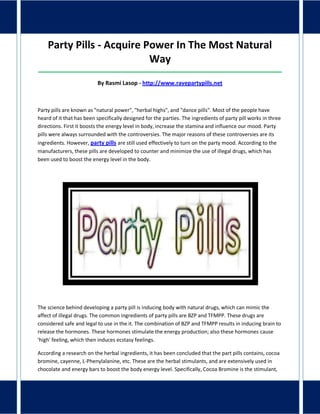
- Most piperazines act as central nervous system stimulants.
- Stimulant drugs, such as cocaine, amphetamine, and 3,4methylenedioxymethamphetamine (MDMA), remain the most commonly used group of illicit psychoactive drugs after cannabis.
- However, little is known about their toxic effects and risks.
- In late June 2007, BZP was classed as a Class C drug in New Zealand and its availability was banned by a law passed on 13 March 2008, with a six-month amnesty period.
- UV-VIS spectra of benzyl- and phenyl derivatives of piperazine and pentedrone.
- While the pharmacokinetic data have recently been published, little research has been conducted on the subjective effects of these piperazines on humans.
Over the last decade, New Zealand has led the world in the legal sale and uncontrolled use of the recreational drug benzylpiperazine (BZP), the active ingredient of 'party pills'. Taking 5-HTP 'recovery' pills with party pills may increase the risk of adverse effects as both substances increase users' levels of serotonin. The purpose of this paper was to assess a general population sample of party pill users to investigate the relationship between (1) patterns of use of BZP/TFMPP party pills and concurrent use of other drug types, and (2) adverse side effects from BZP/TFMPP party pill use. In countries such as New Zealand where BZP and related piperazines have been made illegal, there is now increasing commercial interest in piperazine-free "party pills" which are purported to produce similar effects with ingredients that will circumvent the ban.
(2008), ‘The benzylpiperazine (BZP)/trifluoromethylphenylpiperazine (TFMPP) and alcohol safety study’, Medical Research Institute of New Zealand, Wellington. (2001), ‘The subjective effects of MDMA and mCPP in moderate MDMA users’, Drug and Alcohol Dependence, Volume 65, No 1, pp. 97–101. (2008), ‘Investigation of the first deaths in the United Kingdom involving the detection and quantitation of the piperazines BZP and 3-TFMPP, Journal of Analytical Toxicology, Volume 32, No 2, pp. 172–177. (2008), ‘Analyses of illegal drugs in Belgium, 2008’, Report by the Scientific Institute of Public Health, Brussels.
Benzylpiperazine
Thus, it is possible to conclude that the two substances are stable in plasma and urine even after 30 days of storage, especially if stored at -20 ℃. In urine, both substances are stable for the three concentrations at -20 ℃ after 30 days, with only a slight increase over 20% CV for the lowest concentration. Marginal increases in CV% values were also noted for BZP (0.016 μg/mL at 4 ºC) and for TFMPP (10 μg/mL at 4 ºC and 0.016 μg/mL at -20 ºC).