In 2002 the dark web began to grow significantly when researchers backed by the U.S. Freenet was originally intended to provide a way to anonymously interact online, providing ways to communicate, exchange information and files, and to otherwise communicate incognito. The users of the dark web are typically aiming to block governments from snooping on them.
Dark Web Safety Tips
But for those seeking privacy, freedom of expression, or simply a glimpse into this hidden world, the Dark Web is a fascinating, albeit dangerous, place to explore. For anyone considering exploring the Dark Web, it’s crucial to tread with caution. As the digital world continues to evolve, the Dark Web will undoubtedly remain an important and often controversial part of the internet’s landscape.
Is The Dark Web Illegal?
Scammers prowl the dark net, launching fake storefronts that vanish overnight, often with their victims’ money. Think of the Internet as an iceberg – what you see is only a fraction of what exists beneath the surface. It is now one of the most widely used browsers to access the dark web. Originally created by the US military to enable secure and anonymous communication, this hidden layer of the Internet has since evolved into a complex digital underground. If your information surfaces in these murky depths, there’s very little you can do – but knowing the risks involved is a first step toward defence.
The vast majority of transactions consisted of illegal drugs, but you could also find weapons, personal information, child pornography and stolen credit card details. The Silk Road was a marketplace on the dark web that launched in 2011, where you could purchase all sorts of illegal goods. Instead of relying solely on HTTPS, you can verify site authenticity through multiple trusted sources, such as official PGP signatures or well-known directories. Ensuring a secure connection is crucial when browsing the deep web — though Tor encrypts traffic natively, many dark web sites lack SSL certificates. This means that if you do anything illegal on the dark web and are unlucky enough to be routed through one of these nodes, the authorities will be well aware of what you’re doing.
Related Content
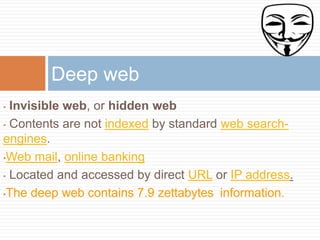
The deep web is the hidden and invisible part of the internet that lies behind the paywall. Despite the internet’s massive size, only about 10% is the surface web. Tech researcher and writer with a passion for cybersecurity. After more than a year of no updates, the site admin shut it down, reasoning that he couldn’t keep the list of onion links up-to-date. It hosted over 7,000 .onion categorized links to make surfing the web easier.
Did you know that we can only access 4% of the resources from some of the most popular search engines like Google, Bing, etc. The dark web's anonymity features make it attractive for illegal activities while complicating law enforcement efforts. The security implications of the surface web differ significantly from its hidden counterparts. This structure benefits data protection, as financial records or research data stay confidential, but it complicates access for authorized parties. Content remains invisible to search engines, requiring users to possess specific credentials or URLs.
Alternative Anonymous Networks
More importantly, you should now know how to access these hidden sectors of the internet at your leisure. You can also use security tools with AI-powered scam detection capabilities to identify and block suspicious links and websites in real-time when browsing the dark web. This means that if you’re accessing non-HTTPS websites, the exit node operator could potentially view your unencrypted traffic. Broadly, this is the process of storing and categorizing the web pages and sites found by the search provider’s crawler bots, so that it can more easily find relevant results when users search for something. Many regular websites now also offer onion addresses (basically the .com or .net of the deep net) you can use to access said sites through the deep web, with examples ranging from DuckDuckGo to ProPublica and even social media sites like Facebook.
While this makes it a popular choice for privacy-focused users, it also opens the door to hidden risks. But while it can support legitimate uses such as whistleblowing or journalistic sources, it’s also a hub for illegal activity. Knowing the differences between the deep web and dark web can help protect your online safety when and if you choose to access each. In fact, only about 4% of the web is indexed, meaning it shows up in standard search engines. Most of what you see in search results is just a small slice of the internet. Take a closer look at the differences between the two, and use Norton 360, with built-in VPN and AI-scam technology, to encrypt the data you send and receive online and help protect against scams.
Is It Illegal To Access The Deep Web?
You can also use its .onion link via the Tor network to access the site in restrictive countries, where it might be unavailable. The best news is Torch updates its sites every single day, so you’ll always be able to browse the latest news and access new services and sites. Torch is one of the oldest dark web search engines, and it’s generally considered one of the safest.
SecureDrop
Also, be wary of RATs (Remote Administration Tools) that malicious actors might try to install through dark web sites to gain control of your system. You should consider using data breach monitoring tools to regularly check if your personal information has been leaked onto the dark web. However, if you’re planning to use it for illegal activities, there are significant risks involved. The dark web refers to the subsection of the deep web that provides illegal services. This means that if you want to access a site on the deep net, you need to know the specific web address beforehand or use a dedicated deep web search engine, as traditional ones like Google won’t be able to help you.

Darknets are encrypted overlay networks that sit on top of the public Internet. The Onion Router (TOR) technology used by the TOR browser and the Dark Web was created by a project funded by the US Naval Research Lab (NRL). Cybercriminals take advantage of the privacy and anonymity that the Dark Web provides for a variety of purposes. This is the primary reason why the US NRL developed the TOR technology used by most Dark Web visitors.
You can check our guide on the best VPN services to find the right VPN solution to protect your privacy. This prevents anyone—including your ISP—from knowing that you’re using the Tor network. Using a VPN alongside Tor adds an extra layer of security by hiding your IP address from Tor entry nodes and encrypting your traffic. It offers better speed and security than other alternative methods. You will never know when you stumble upon illegal materials, inadvertently download malicious software, or expose yourself to identity theft.
Legal Vs Illegal Activities
Therefore, this content is inaccessible to most online users, and it is difficult to track the visitors of such websites. Instead, users rely on dark web search engines like DuckDuckGo or directories, such as the Hidden Wiki and its offshoots, to find .onion websites. The dark web refers to websites that are not on the regular internet but are instead hidden in a private network that is only accessible using specialized web browsers, such as the Tor Browser. All the websites and services you visit when searching on Google, Bing, or other regular search engines are part of the surface web, which is also known as the Clear Web.
Unlike the surface web (the normal, open internet we use every day), you can’t search for .onion sit… Another main upside to this site is that it lets you view the number of .onion links and users on the Tor browser network. In addition, Haystak offers a premium plan that allows deeper search, email alerts, and access to historical content. However, the dark web’s anonymity makes it a hotbed for illicit actors and services, such as criminal groups and other nefarious activities. Most dark web pages are onion websites, which are not accessible by all browsers but only to a select few.
What To Do If You See Something Illegal
For example, to access the popular dark web forum CryptBB, you must know the exact onion link; conducting a web search for the forum will not turn up anything useful. Darknets and Dark Web sites are encrypted, peer-to-peer networks that are only accessible via certain tools. Darknets are designed for anonymity and privacy, making them ideal for criminals to communicate and buy and sell illegal goods and services. Since the Dark Web is a collection of websites that are only accessible via darknets, let’s take a moment to define what darknets are. Other content on the Deep Web include private files like medical records, legal documents, and sites that have blocked search engine crawlers. This makes these sites valuable sources of information if the content is accessible.
- Any online activity can carry breadcrumbs to your identity if someone digs far enough.
- When navigating beyond the surface web, there are a few key differences to keep in mind when venturing into the deep and dark web.
- We have included a variety of sites with specific functions.
- Privacy-focused communications, whistleblowing, secure journalism, and individuals under restrictive regimes requiring anonymity
It's One Of The Oldest Existing Web Resources
3g2upl4pq6kufc4m – Duck Duck Go – This is probably “the” most privacy-respecting search engine on the planet. Just like the CIA website above, this version too exists just for added anonymity and privacy while still being 100% legal. As far as legal usage goes, you can contact the CIA, or just read the news from them, anonymously on this onion version. Another legal use of the Deep web are sites like ProPublica, which are anonymous whistle blowing sites which anyone can use to share exposing documents or truths about powerful people or agencies. So basically once you have the URLs you wish to access, and the Tor browser, you can access the dark or deep web just like any other normal website.